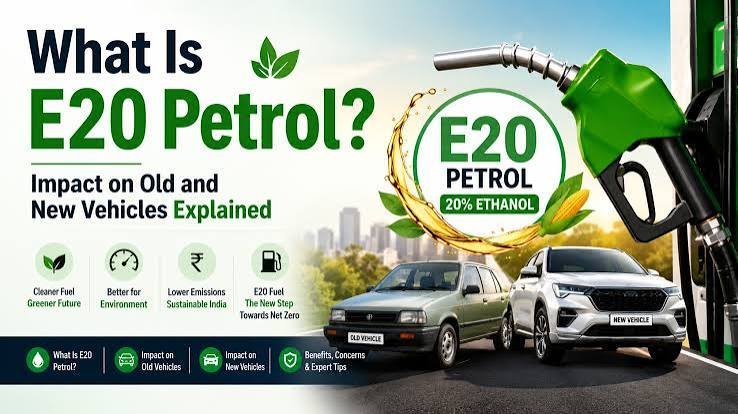
Every petrol pump in India now sells E20 petrol, a fuel blended with 20% ethanol, following the government’s nationwide mandate that took effect on April 1, 2026. If you drive an older car or two-wheeler, this shift has likely raised a simple but important question: is your vehicle designed to handle it? This guide explains what E20 petrol actually is, why India made the switch, and what it realistically means for the mileage, engine health, and maintenance needs of both older and newer vehicles.
E20 petrol is a fuel blend containing 20% ethanol and 80% petrol, with a minimum Research Octane Number (RON) of 95. It has been mandatory at all petrol pumps across India since April 1, 2026, as part of the government’s Ethanol Blending Programme. Vehicles made after 2023 are generally E20-compatible, while older petrol vehicles may experience a mileage drop and faster wear of rubber fuel-system components.
What Does E20 Petrol Mean?
E20 petrol is a mix of 80% conventional petrol and 20% ethanol, an alcohol-based biofuel produced from crops like sugarcane, maize, and other grains. The government has set a minimum RON of 95 for this blend, which is higher than the RON 91–92 typically seen in earlier petrol standards. A higher octane rating generally means the fuel resists engine knocking better and supports smoother combustion, though the practical benefit varies by vehicle.
E20 is the next stage after E10 (10% ethanol-blended petrol), which India achieved in June 2022. The move to 20% blending was originally targeted for 2030 but was advanced to 2025–26, and the Ministry of Petroleum and Natural Gas has now made E20 the default fuel nationwide, with only limited, temporary exemptions permitted in special circumstances.
Why Has India Made E20 Petrol Mandatory?
The Ethanol Blending Programme is built around three core objectives:
- Cutting crude oil imports: India imports a large share of its crude oil. Ethanol blending reduces this dependence and improves energy security. Official estimates suggest ethanol blending has helped India save well over ₹1 lakh crore in foreign exchange since 2014–15.
- Reducing emissions: Since ethanol is plant-based, it can lower certain vehicle emissions. Assessments suggest sugarcane- and maize-based ethanol can meaningfully cut greenhouse gas output compared to pure petrol, though the full lifecycle impact is debated.
- Supporting farmers and rural income: Higher ethanol demand increases the requirement for sugarcane, maize, and other crops, creating an additional revenue stream for farmers and the agriculture-linked ethanol industry.
E20 Petrol: Impact on New Vehicles
If your vehicle was manufactured from 2023 onward, you are less likely to notice a meaningful difference. Most vehicle manufacturers in India — including major carmakers and two-wheeler brands — have confirmed that vehicles built to current BS6-era standards are engineered for E20 compatibility, with fuel systems, seals, and engine calibration designed to handle ethanol-blended fuel without voiding the warranty.
In these vehicles:
- Mileage impact is typically minor, often cited in official assessments as roughly a 1–4% dip compared to running on lower-ethanol fuel.
- The higher octane rating can partially offset ethanol’s lower energy density, so some owners report only a marginal change.
- Engine and fuel-system components are built with ethanol-resistant materials, reducing the risk of corrosion or seal degradation.
E20 Petrol: Impact on Old Vehicles
Vehicles manufactured before 2023, particularly those built to older BS3 or BS4 emission norms, were generally designed for petrol with little or no ethanol (E0–E10). These vehicles are more likely to show visible effects:
- Mileage drop: Independent surveys of vehicle owners have reported noticeably lower fuel efficiency in older cars and two-wheelers after switching to E20, in some cases in double digits, though results vary widely by vehicle condition and maintenance history. The government’s own assessment has acknowledged some dip in mileage for older vehicles as well, though it places the figure lower than many consumer surveys.
- Component wear: Ethanol is hygroscopic, meaning it can absorb moisture from the air. Over time, this can contribute to corrosion in metal fuel tanks and faster degradation of rubber seals, gaskets, and fuel lines that were not designed for higher ethanol content.
- Performance issues: Some owners of older vehicles, especially carbureted two-wheelers, have reported hard starting, rough idling, or fuel filter and injector clogging after prolonged use of ethanol-blended fuel.
It’s worth noting that manufacturers and industry bodies have stated that E20 does not automatically damage engines or void warranties, and the government has said its internal studies found no major evidence of widespread engine failure. However, owner experiences reported through consumer surveys suggest older vehicles do face a higher likelihood of maintenance issues than newer, E20-designed ones.
E20 Petrol vs Regular Petrol: Quick Comparison
| Factor | E20 Petrol | Earlier Petrol (E10/E0) |
|---|---|---|
| Ethanol content | 20% | 10% or less |
| Minimum octane (RON) | 95 | 91–92 |
| Energy density | Slightly lower | Slightly higher |
| Best suited for | Vehicles made 2023 onward | Older, pre-2023 vehicles |
| Mileage impact on old vehicles | Possible noticeable drop | Not applicable |
| Availability in India | Mandatory at all pumps | Being phased out |
| Component wear risk (old vehicles) | Higher over time | Lower |
How to Reduce E20-Related Issues in Your Vehicle
If you own an older petrol vehicle, a few precautions can help minimise the impact:
- Check compatibility: Look at your owner’s manual, fuel cap, or contact an authorised service centre to confirm your vehicle’s ethanol tolerance.
- Service fuel system components: Get rubber seals, gaskets, and fuel lines inspected periodically, and replace them with ethanol-resistant parts if recommended.
- Keep the tank fairly full: This reduces the air space where moisture can condense and mix with the fuel.
- Use fuel system cleaners: Periodic use of manufacturer-approved additives can help prevent deposit buildup in injectors or carburettors.
- Track your mileage: Monitoring fuel efficiency before and after a full tank of E20 gives a realistic picture of the actual impact on your specific vehicle.
- Stick to authorised service centres: For warranty-related concerns or unusual wear, get the vehicle checked by the manufacturer’s network rather than relying on assumptions.
Does E20 Petrol Affect Your Vehicle Insurance?
The government has stated that using E20 fuel does not affect the validity of a vehicle’s insurance policy. However, it’s worth understanding what a standard motor insurance policy does and doesn’t cover:
- Wear-and-tear related engine damage — including gradual degradation from fuel-related corrosion — is typically excluded under a standard comprehensive own-damage policy, as most insurers treat this as a maintenance issue rather than an insurable accident.
- Sudden and accidental damage — such as an engine failure directly linked to a documented fuel contamination event — may be assessed differently depending on the insurer’s policy wording and the circumstances.
- Engine protection add-on cover, where available, is designed to extend protection for specific engine and gearbox damage scenarios, subject to the insurer’s terms and conditions.
Because coverage for engine-related issues varies by insurer and plan, it’s advisable to review your policy wording or speak with your insurer about what is and isn’t included, especially if you drive an older, non-E20-compatible vehicle.
Frequently Asked Questions
Q1. What is E20 petrol in simple terms? E20 petrol is regular petrol blended with 20% ethanol, a plant-based biofuel. It has a minimum RON of 95 and has been mandatory at all petrol pumps in India since April 1, 2026.
Q2. Is E20 petrol safe for all cars? E20 petrol is generally considered safe to use, and most manufacturers say it will not automatically void your warranty. However, older vehicles not originally designed for higher ethanol blends may experience reduced mileage and faster wear of certain rubber and fuel-system components over time.
Q3. How much does E20 petrol reduce mileage? The impact varies. Newer, E20-compatible vehicles typically see a marginal dip, often in the low single digits. Older, pre-2023 vehicles have reported larger drops in various consumer surveys, though official government assessments cite a smaller range. Actual results depend on the vehicle’s age, maintenance, and driving conditions.
Q4. Which vehicles are E20 compatible? Most vehicles manufactured in India from 2023 onward, aligned with BS6 phase 2 norms, are built to handle E20 fuel. You can confirm compatibility through your owner’s manual, fuel cap markings, or your vehicle manufacturer’s official communication.
Q5. Can I still get pure petrol (E0) or E10 in India? Since the nationwide mandate took effect, E20 is now the standard fuel at petrol pumps across the country, and E10 or E0 petrol is largely unavailable outside of limited exemptions in special cases.
Q6. Does E20 petrol damage two-wheeler engines? Older, carbureted two-wheelers with rubber and plastic components not designed for higher ethanol content are more prone to issues like fuel line degradation and clogging. Most current BS6-compliant two-wheelers from major manufacturers are built for E20 compatibility.
Q7. What should I do if I own an older vehicle and I’m worried about E20? Get your fuel system checked at an authorised service centre, consider ethanol-compatible fuel additives, keep your tank reasonably full, and monitor your mileage to understand the real-world impact on your specific vehicle.
Q8. Does using E20 petrol affect my car insurance claim? Using E20 fuel by itself does not invalidate your insurance policy. However, standard wear-and-tear related engine damage is usually not covered under a basic own-damage policy; coverage for specific engine issues depends on your insurer’s terms and any add-on covers you may have opted for.
Conclusion
E20 petrol is now the default fuel across India, and for most newer vehicles, the transition should be relatively smooth. Owners of older, pre-2023 petrol vehicles are the ones most likely to notice changes in mileage or need closer attention to fuel-system maintenance. Rather than reacting to worst-case reports, the most practical approach is to confirm your vehicle’s compatibility, stay on top of routine servicing, and understand what your insurance policy actually covers when it comes to engine-related issues.
Also Know – Buy, Compare & Renew Car Insurance Policy Online