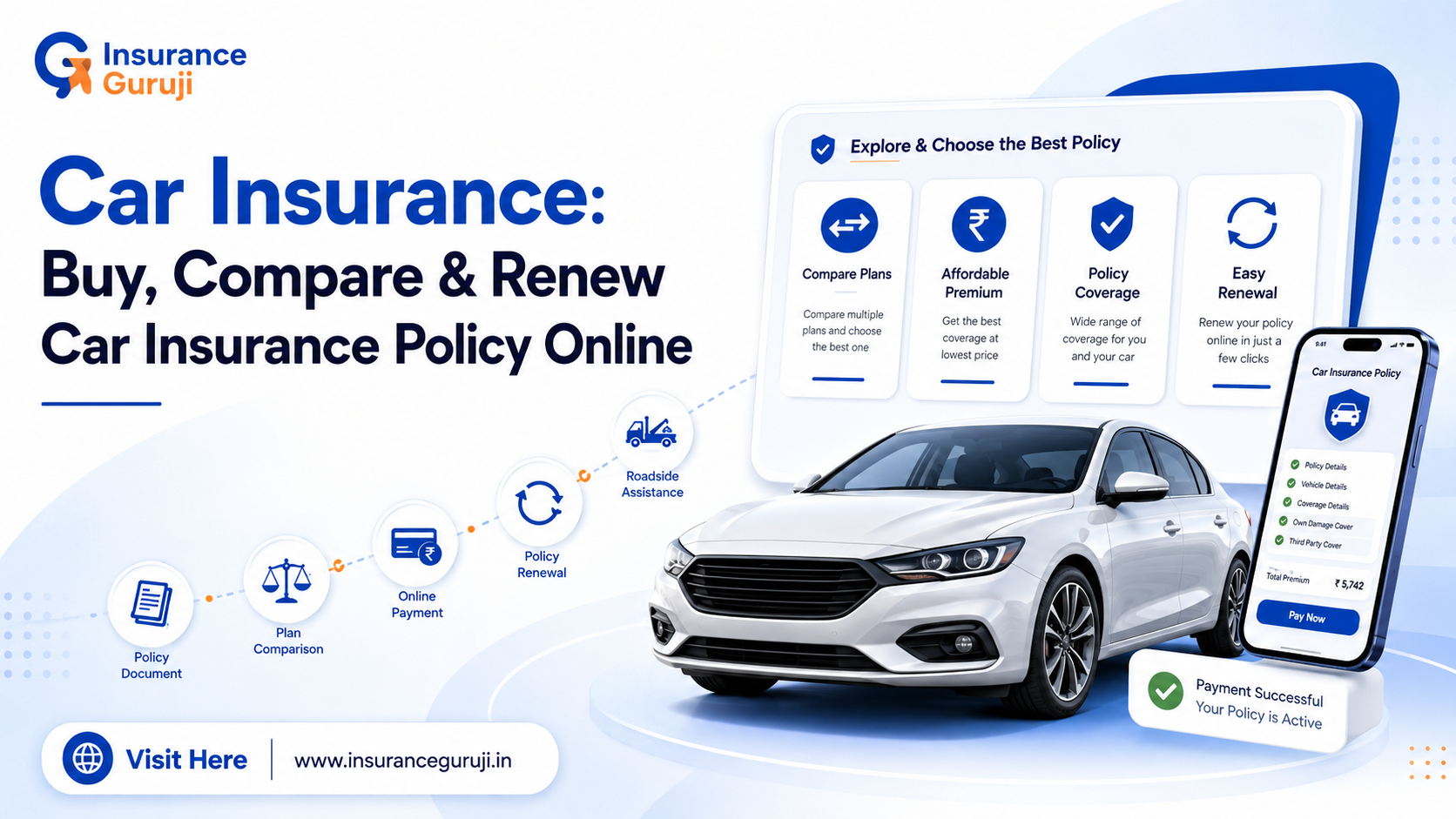
Car insurance is not just a legal requirement in India — it is your financial shield against the unexpected costs of accidents, theft, natural disasters, and third-party liability. Whether you’re buying a new policy or renewing an existing one, the right car insurance ensures you’re never left covering large repair or compensation bills out of pocket.
Under the Motor Vehicles Act, 1988, every car on Indian roads must carry at least third-party car insurance. Driving without it can lead to fines, legal penalties, and full personal liability for third-party damages. A comprehensive car insurance policy goes further — it also protects your own vehicle from a wide range of risks.
This page covers everything you need to make an informed decision: types of car insurance, what is covered, what is excluded, how premiums are calculated, how to compare plans, how to buy or renew online, and how the claim process works.
Car insurance is a policy that provides financial protection to a vehicle owner against losses caused by accidents, theft, fire, natural calamities, and third-party damage. In India, third-party car insurance is legally mandatory under the Motor Vehicles Act, 1988. A comprehensive car insurance policy additionally covers own damage to your vehicle. Premiums are calculated based on vehicle type, age, IDV, add-ons, and No Claim Bonus.
What Is Car Insurance?
Car insurance — also known as motor insurance or vehicle insurance — is a contract between a car owner and an insurance company. In exchange for a periodic premium payment, the insurer agrees to compensate for financial losses arising from covered incidents, up to the policy’s Insured Declared Value (IDV) or applicable limit.
Car insurance claims broadly fall into two categories:
- Own damage (OD) claims: When your car suffers loss or damage due to an accident, theft, flood, fire, or other covered perils
- Third-party claims: When your car causes injury, death, or property damage to another person or vehicle
The extent of coverage depends on the type of car insurance policy you hold and the add-ons you have selected.
Why Is Car Insurance Mandatory in India?
The Motor Vehicles Act, 1988, makes third-party car insurance compulsory for all vehicles on Indian roads. The Motor Vehicles Amendment Act, 2019, further strengthened penalties for non-compliance.
If caught driving without valid insurance:
- Fine of up to ₹2,000 for the first offence
- Fine of up to ₹4,000 for subsequent offences
- Possible imprisonment of up to 3 months
- Full personal financial liability for all third-party damages, with no insurer support
Beyond legal compliance, car insurance offers critical practical protection:
- Shields you from large, sudden repair and medical bills after an accident
- Covers complete vehicle loss due to theft
- Protects third parties who may suffer injury or property damage due to your car
- Provides mandatory Personal Accident (PA) cover of ₹15 lakh for the owner-driver
Without car insurance, a single accident on a busy city road can result in lakhs of rupees in damages — vehicle repairs, legal costs, third-party medical bills, and compensation.
Types of Car Insurance Plans in India
There are three types of car insurance policies available in India:
1. Third-Party Car Insurance
Third-party car insurance is the minimum coverage legally required under Indian law. It covers:
- Death or bodily injury caused to a third party by your vehicle
- Damage to a third-party vehicle
- Damage to third-party property (up to ₹7.5 lakh, as per IRDAI guidelines)
What it does not cover: Any damage to your own car, regardless of how the accident occurred.
Third-party premium rates are set and regulated by IRDAI based on the vehicle’s engine cubic capacity (CC). They cannot be altered by the insurer.
Best for: Older cars with low market value where own damage coverage may not be cost-effective relative to the vehicle’s worth.
2. Comprehensive Car Insurance
A comprehensive car insurance policy combines third-party liability cover with own damage (OD) cover. It is not legally mandatory but is strongly recommended for any car with significant value.
What comprehensive car insurance covers:
- All third-party liabilities (same as standalone third-party policy)
- Accidental damage to your own car
- Theft of the vehicle
- Fire and explosion damage
- Natural calamities — floods, earthquakes, landslides, cyclones, hailstorm, inundation
- Man-made events — riots, strikes, terrorist activity, malicious acts
- Transit damage (damage during transportation by road, rail, water, or air)
Best for: New cars, high-value cars, cars under a loan or hypothecation, and any car owner who cannot afford to self-fund significant repair costs.
3. Standalone Own Damage (OD) Cover
A standalone OD policy covers only damage to your own car. It does not include third-party liability.
This option became relevant after IRDAI’s 2018 regulation requiring new cars to carry a mandatory 3-year (for cars) or 5-year (for two-wheelers) third-party policy. Owners with a long-term third-party policy can buy a separate annual OD policy for own damage coverage.
Third-Party vs Comprehensive Car Insurance — At a Glance
| Feature | Third-Party Car Insurance | Comprehensive Car Insurance |
|---|---|---|
| Legal requirement | ✅ Mandatory | ❌ Not mandatory (but recommended) |
| Own vehicle damage | ❌ Not covered | ✅ Covered |
| Third-party liability | ✅ Covered | ✅ Covered |
| Theft cover | ❌ Not covered | ✅ Covered |
| Natural calamity cover | ❌ Not covered | ✅ Covered |
| Add-on covers | ❌ Not available | ✅ Available |
| Premium level | Lower | Higher |
| Best suited for | Old/low-value cars | New / high-value cars |
Key Benefits of Car Insurance
A comprehensive car insurance policy delivers the following core benefits:
- Legal compliance: Meets the mandatory third-party insurance requirement under the Motor Vehicles Act
- Own damage protection: Covers repair or replacement costs after accidents, fire, theft, floods, and other perils
- Third-party financial protection: Pays compensation for injury, death, or property damage caused to others by your vehicle
- Mandatory PA cover: ₹15 lakh personal accident cover for the owner-driver in case of accidental death or permanent total disability
- Cashless repairs: Authorised network garages settle your repair bill directly with the insurer — no upfront payment required
- No Claim Bonus (NCB): Earn up to 50% discount on renewal premium for every consecutive claim-free year
- Flexible add-ons: Customise your policy with zero depreciation, engine protection, roadside assistance, return to invoice, and more
- E-car insurance delivery: Policy document issued instantly to your email — no paperwork, no delays
What Does Car Insurance Cover?
Third-Party Liability Cover (Mandatory Under All Car Insurance Policies)
- Death or bodily injury to a third party
- Damage to a third-party vehicle
- Third-party property damage (up to ₹7.5 lakh as per IRDAI)
Own Damage Cover (Under Comprehensive Policies)
- Accidental collision damage to your car
- Damage due to fire, self-ignition, or explosion
- Theft of the vehicle or its parts
- Natural perils: floods, earthquakes, landslides, hailstorm, cyclone
- Man-made perils: riots, strikes, malicious damage, terrorist activity
- Transit damage during transportation by road, rail, inland waterway, air, or lift
Personal Accident Cover
- ₹15 lakh compulsory PA cover for the owner-driver (mandatory for all new policies)
- Covers permanent total disability and accidental death
- Optional PA cover for passengers/co-passengers available as an add-on
Add-On Covers Available with Comprehensive Car Insurance
Here are the list of add-ons covers in car insurance
| Add-On Cover | What It Protects |
|---|---|
| Zero Depreciation | Full claim payout on parts without deduction for depreciation — especially valuable for new cars |
| Engine Protection Cover | Damage to the engine and gearbox due to water ingression, oil leakage, or hydrostatic lock |
| Return to Invoice (RTI) | In case of theft or total loss, the insurer pays the full original purchase invoice value instead of depreciated IDV |
| Roadside Assistance (RSA) | Emergency breakdown help including towing, battery jump-start, flat tyre change, fuel delivery, and key lockout support |
| NCB Protect | Retains your No Claim Bonus discount at renewal even after one claim in the policy year |
| Key Replacement Cover | Cost of replacing a stolen, lost, or damaged car key and lock system |
| Consumables Cover | Covers the cost of engine oil, coolant, nuts, bolts, brake oil, and other consumables replaced during repairs |
| Tyre Protection Cover | Covers accidental tyre damage including cuts, bursts, and bulges not caused during a road accident |
| Daily Allowance Cover | Pays a daily allowance during the period your car is in the garage for claim-related repairs |
| Passenger PA Cover | Personal accident cover for named co-passengers or unnamed passengers in the vehicle |
Note: Add-on covers are only available with comprehensive or standalone OD policies — not with third-party only policies. Each add-on increases your premium. Select only those relevant to your usage and car age.
What Is Not Covered in Car Insurance? (Exclusions)
Understanding exclusions is essential — these are situations where the insurer will not settle your claim:
- Driving without a valid licence: Claim will be rejected if the driver did not hold a valid driving licence at the time of the incident
- Driving under the influence: Claims arising when the driver was under the influence of alcohol or drugs are excluded
- Policy lapse: No coverage is valid if the policy had expired at the time of the incident
- Mechanical or electrical breakdown: General wear and tear, engine failure due to manufacturing defect, or mechanical breakdown are not covered
- Depreciation (without zero dep add-on): Standard policies deduct depreciation on replaced parts; zero depreciation add-on removes this deduction
- Consequential losses: Damage that arises indirectly as a consequence of the insured event (e.g., engine damage due to driving through a flooded road when the car was already damaged) may not be covered
- Illegal use: Losses arising when the car was being used for racing, unlawful purposes, or in a prohibited area
- Use outside geographical limits: Losses occurring outside India are generally not covered (check policy for Nepal/Bhutan extensions)
- War, nuclear risk, mutiny: Losses arising from war, invasion, rebellion, or nuclear activity
- Commercial use without appropriate policy: Using a private car policy-registered vehicle for paid commercial transport without a commercial vehicle policy
Tip: Always read the exclusions clause carefully before buying. Not disclosing material facts — such as vehicle modifications or change of use — can also lead to claim rejection.
Who Is Eligible to Buy Car Insurance?
Car insurance can be purchased by any legal owner or registered user of a motor vehicle in India. Key eligibility requirements:
- The vehicle must be registered with the relevant Regional Transport Office (RTO)
- The owner must possess a valid driving licence for owner-driver PA cover eligibility
- Vehicles with existing hypothecation/loan must show the financier’s name in the policy
- Vehicles with a lapsed policy for more than 90 days (varies by insurer) may require a fresh inspection
Who can be covered:
- Individual private car owners
- Companies owning vehicles (commercial policies may be needed for business use)
- Vehicles under hire purchase or hypothecation agreements
What Is IDV in Car Insurance?
Insured Declared Value (IDV) is the market value of your car as assessed by the insurer at the time of policy issuance or renewal. It is the maximum amount the insurer will pay in case of theft or total/constructive total loss of your vehicle.
How IDV is calculated:
IDV = Manufacturer’s listed selling price − Depreciation (based on vehicle age)
| Vehicle Age | Depreciation Rate Applied |
|---|---|
| Up to 6 months | 5% |
| 6 months to 1 year | 15% |
| 1 to 2 years | 20% |
| 2 to 3 years | 30% |
| 3 to 4 years | 40% |
| 4 to 5 years | 50% |
(For vehicles older than 5 years, IDV is mutually agreed between insurer and policyholder.)
What this means for you:
- A higher IDV offers better financial protection in theft or total loss but increases your premium
- A lower IDV reduces premium but may result in under-compensation if your car is stolen or totalled
- Always verify that the IDV shown at renewal accurately reflects the current market value of your vehicle — do not agree to an artificially low IDV just to reduce premium
What Factors Affect Car Insurance Premium?
Your car insurance premium is not a flat rate. It is calculated based on several interconnected factors:
Vehicle-Related Factors
- Make, model, and variant: Luxury, imported, or high-performance cars attract higher premiums
- Engine cubic capacity (CC): Higher CC means higher third-party premium as per IRDAI tariff
- Age of vehicle: IDV decreases as the car ages, reducing the OD premium component
- Fuel type: Petrol, diesel, CNG, or electric vehicles may have different pricing
- Vehicle modifications: Any non-standard modification must be disclosed and can affect premium
Owner-Related Factors
- No Claim Bonus (NCB): Accumulated NCB from previous claim-free years reduces renewal premium
- Voluntary deductible: Opting for a higher voluntary deductible lowers your premium but increases what you pay at the time of a claim
- Anti-theft device: ARAI-approved anti-theft devices may attract a discount on OD premium
Policy-Related Factors
- Type of cover: Third-party vs comprehensive vs OD only
- Add-ons selected: Each add-on increases the base premium
- IDV chosen: Higher IDV = higher premium
- Policy tenure: Single year vs multi-year policies
- City/RTO zone: Vehicles registered in metro cities typically attract higher premiums than Tier 2/3 cities
No Claim Bonus (NCB) in Car Insurance — Explained
No Claim Bonus (NCB) is a reward for responsible driving. If you don’t make any claims during a policy year, you earn a discount on your Own Damage premium at renewal.
| Consecutive Claim-Free Years | NCB Discount |
|---|---|
| 1 year | 20% |
| 2 years | 25% |
| 3 years | 35% |
| 4 years | 45% |
| 5 years or more | 50% |
Key things to know about NCB:
- NCB applies only to the Own Damage (OD) component — not the third-party premium
- NCB belongs to the owner, not the vehicle — it can be transferred when buying a new car
- Making a claim results in forfeiture of accumulated NCB
- NCB Protection add-on allows you to retain your NCB even after one claim per policy year
- NCB can be carried to a new insurer if you switch at renewal — you’ll need an NCB certificate
How to Compare Car Insurance Plans
Do not choose car insurance purely on the basis of premium. The cheapest option may leave significant coverage gaps. Compare on:
| Comparison Factor | What to Check |
|---|---|
| IDV | Should reflect the realistic current market value of your car |
| Add-on options | Essential covers like zero dep, engine protection, RSA should be available |
| Network cashless garages | More and closer network garages = more convenient repairs |
| Claim Settlement Ratio (CSR) | IRDAI publishes annual data — a higher CSR signals better claim reliability |
| Premium vs coverage balance | A low premium is meaningless if critical coverage is absent |
| Sub-limits and co-payment | Check for room rent limits, co-payment clauses, or repair cost caps |
| Exclusions | Read the policy document for conditions that can limit your claim |
| Deductibles | Compulsory deductible is fixed; voluntary deductible affects your out-of-pocket cost in a claim |
| Insurer’s claim support | Helpline availability, claim turnaround time, and online claim tracking |
How to Buy Car Insurance Online
Buying car insurance online (e-car insurance) is fast, completely paperless, and typically takes less than 10 minutes.
Steps to Buy Car Insurance Online
Step 1: Visit the insurer’s website, app, or an authorised insurance comparison platform
Step 2: Enter your car registration number — most platforms auto-fetch vehicle details for registered cars
Step 3: Select your coverage type — third-party only or comprehensive
Step 4: Review and choose add-ons relevant to your needs (zero dep, engine protection, RSA, etc.)
Step 5: Review the IDV — confirm it reflects the accurate current market value of your vehicle
Step 6: Compare premium, coverage, and plan features across available options
Step 7: Enter personal details, previous policy details, and NCB (for comprehensive policies)
Step 8: Make payment online — via UPI, net banking, credit/debit card
Step 9: Receive your e-car insurance policy document instantly on your registered email ID
Your e-car insurance policy is 100% valid and legally accepted across India. Traffic authorities accept digital insurance proof on mobile devices — a printed copy is not required.
How to Renew Car Insurance Online
Renewing car insurance before the expiry date is critical to maintaining continuous coverage and preserving your NCB.
Steps to Renew Car Insurance Online
Step 1: Visit your insurer’s website/app or a licensed aggregator platform
Step 2: Enter your existing policy number, registered mobile number, or car registration number
Step 3: Review current coverage and IDV — update IDV if it doesn’t reflect the car’s current market value
Step 4: Add, remove, or update add-ons based on your current requirements
Step 5: Verify that your accumulated NCB is correctly applied to the renewal premium
Step 6: Check and confirm the revised premium
Step 7: Make payment online
Step 8: Receive your renewed e-car insurance policy instantly by email
What Happens If Your Car Insurance Policy Lapses?
If your policy expires and is not renewed within the insurer’s applicable grace period (which may range from 0 to 90 days depending on the insurer), the following consequences apply:
- You have no insurance coverage during the lapse period — driving without coverage is a legal violation
- You may lose your accumulated NCB if renewal is delayed beyond a certain period
- A fresh vehicle inspection may be required before the insurer issues a new policy
- Claim for any incident occurring during the lapse period will not be entertained
Practical advice: Set a policy renewal reminder at least 30 days before your policy’s expiry date. Renewing on time ensures you do not lose NCB and avoids the need for a fresh vehicle inspection.
Car Insurance Claim Process — Step by Step
Step 1: Inform the Insurer Immediately
Contact your insurer’s claims helpline, app, or website as soon as possible after the incident. Provide:
- Policy number
- Date, time, and location of the incident
- Brief description of what happened and the nature of damage
Most insurers have 24/7 claims helplines. Prompt intimation is important — delays in informing the insurer can complicate the claim.
Step 2: File an FIR (Where Required)
An FIR at the local police station is required for:
- Vehicle theft
- Accidents involving third-party injury or death
- Certain natural calamity or major damage situations (insurer may specify)
Step 3: Vehicle Inspection / Survey
The insurer appoints a licensed surveyor to inspect the vehicle damage and assess the claim. Try not to move or repair the damaged vehicle before the surveyor’s inspection unless safety or emergency situations demand it.
Step 4: Choose Cashless or Reimbursement Settlement
Cashless Car Insurance Claim:
- Take the car to an insurer-authorised network garage
- The garage and insurer coordinate directly for repair approval
- The insurer pays the eligible repair amount directly to the garage
- You pay only the uncovered portion: deductibles, depreciation (unless zero dep is active), and non-covered items
Reimbursement Claim:
- Repair the car at any garage of your choice
- Pay the full bill upfront
- Submit original bills, receipts, and required documents to the insurer
- The insurer verifies and reimburses the eligible amount to your bank account
Step 5: Claim Settlement
- Cashless claims are settled directly with the garage after vehicle delivery
- Reimbursement amounts are transferred to your registered bank account post-verification
Step 6: Collect Your Vehicle
Collect your repaired vehicle, sign the satisfaction/delivery confirmation, and retain a copy of all claim documents for your records.
Cashless vs Reimbursement Car Insurance Claim — Comparison
| Feature | Cashless Claim | Reimbursement Claim |
|---|---|---|
| Upfront payment by you | No | Yes — full bill amount |
| Garage choice | Insurer-authorised network garages only | Any garage |
| Convenience | Higher | Lower |
| Settlement speed | Faster — direct with garage | Depends on document submission timeline |
| Paperwork | Minimal at garage | Significant — all bills, receipts, forms |
| Best for | Quick, hassle-free resolution | Remote areas without network garages |
Common Car Insurance Claim Rejection Reasons
Knowing these prevents avoidable rejections:
- Driving without a valid driving licence at the time of the incident
- Policy had already lapsed when the incident occurred
- Driving under the influence of alcohol or drugs
- Using a private car for commercial purposes without appropriate policy
- Damage not covered under policy terms (e.g., mechanical breakdown)
- Claim not intimated to the insurer within the required time
- Non-disclosure of material facts at the time of policy purchase (e.g., vehicle modification)
- Damage cause found inconsistent with the claim during surveyor assessment
Documents Required for Car Insurance
For Buying or Renewing Car Insurance
- Vehicle Registration Certificate (RC)
- Previous car insurance policy copy (for renewal and NCB transfer)
- KYC documents: Aadhaar card, PAN card, or passport
- Valid driving licence
- Passport-size photograph (as required by insurer)
For Filing a Car Insurance Claim
- Valid car insurance policy copy
- Driving licence of the driver at the time of the incident
- Vehicle Registration Certificate (RC)
- FIR copy (for theft, major accidents, or third-party injury)
- Duly completed claim form (provided by insurer)
- Original repair bills and receipts (for reimbursement claims)
- Cancelled cheque or bank account details (for reimbursement payment)
- Photos of vehicle damage
- Survey report from the insurer-appointed surveyor
Tax Benefits on Car Insurance
There is no direct income tax deduction available on car insurance premiums for personal use vehicles under the Income Tax Act.
However, if a vehicle is used exclusively or primarily for business purposes, the car insurance premium may qualify as a business expense and may be deductible under applicable business income provisions. Please consult a qualified tax advisor for guidance specific to your situation.
Frequently Asked Questions (FAQs) on Car Insurance
Q1. Is car insurance mandatory in India? Yes. Third-party car insurance is legally mandatory under the Motor Vehicles Act, 1988. Driving a car without valid third-party insurance can result in fines of up to ₹4,000 and/or imprisonment. Additionally, you become personally liable for all third-party damages without any insurer support.
Q2. What is the difference between third-party and comprehensive car insurance? Third-party car insurance covers only damages or injuries caused to a third party by your car — it does not cover your own vehicle. Comprehensive car insurance covers third-party liabilities as well as own damage to your car due to accidents, theft, fire, floods, and other covered perils. If your car has significant value, comprehensive coverage is the recommended choice.
Q3. What is IDV in car insurance and why does it matter? IDV (Insured Declared Value) is the current market value of your vehicle after depreciation — it is the maximum amount the insurer will pay in case of theft or total loss. A correct IDV ensures you receive fair compensation. An artificially low IDV reduces your premium but can significantly under-compensate you in a total loss situation.
Q4. What is No Claim Bonus (NCB) and how much can I save? NCB is a discount on your Own Damage premium at renewal for every consecutive claim-free year. It starts at 20% after one year and can go up to 50% after five or more claim-free years. NCB can translate into substantial savings on your renewal premium over time.
Q5. Can I renew my car insurance online? Yes. You can renew car insurance online through your insurer’s website, mobile app, or an authorised insurance aggregator. Online renewal is instant, fully digital, and the e-car insurance policy is delivered to your registered email ID immediately after payment.
Q6. What is zero depreciation add-on in car insurance? Zero depreciation (also called nil depreciation or bumper-to-bumper cover) ensures that no depreciation is deducted from your claim payout on car parts. Without this add-on, insurers deduct standard depreciation on plastic, rubber, metal, glass, and fibre parts — which can significantly reduce the net claim amount. This add-on is most beneficial for new or high-value cars.
Q7. What happens if my car insurance policy lapses? If your car insurance lapses, you have no coverage during the lapse period. You may also lose your accumulated NCB. Driving without valid insurance is a legal violation. Depending on how long the policy has lapsed, the insurer may require a fresh vehicle inspection before renewing coverage.
Q8. Can I transfer my NCB when buying a new car? Yes. NCB belongs to the owner, not the vehicle. When you sell your old car and buy a new one, you can transfer your accumulated NCB to the new car’s insurance policy. You will need an NCB certificate from your previous insurer to claim this at renewal or while buying a new policy.
Q9. What is e-car insurance? Is a digital policy legally valid? E-car insurance refers to a motor insurance policy issued and delivered electronically. It is 100% legally valid across India under the Motor Vehicles Act. Traffic enforcement authorities and police accept digital insurance documents on a mobile device as proof of valid insurance. A printed copy is not required.
Q10. How does the cashless car insurance claim process work? In a cashless claim, you bring your car to an insurer-authorised network garage. The garage coordinates with the insurer, which directly settles the eligible repair amount with the garage. You pay only the amount not covered under the policy — such as the compulsory deductible, applicable depreciation (unless zero dep is active), and any non-covered items.
Q11. Can I add or remove add-ons during policy renewal? Yes. Car insurance add-ons can be added, removed, or changed at the time of annual policy renewal. During the policy year, add-ons generally cannot be modified. Use renewal as an opportunity to review whether your current add-ons still match your needs — for instance, you may want to drop zero depreciation on an older car where it may not be cost-effective.
Q12. Can I buy car insurance for a second-hand vehicle? Yes. Car insurance is available for used and second-hand vehicles. The IDV will be calculated based on the vehicle’s age and current market value. You will need the vehicle’s RC, previous insurance details (if available), and standard KYC documents. If buying from an individual seller, ensure the RC is transferred to your name before or alongside the insurance purchase.
3 thoughts on “Car Insurance: Buy, Compare & Renew Car Insurance Policy Online”